 Search
MINISTRY OF EDUCATION
OF THE REPUBLIC OF BELARUS

Education for the future of the country
Registration for centralized testing in 2026 will take place from April 9 to 22. In recent years, more than 70% of applicants have pre-registered for centralized testing through their personal account on the RIKC website. This was stated by Dmitry Mironov, Director of the Republican Institute for Knowledge Control.
"However, applicants must arrive at the registration place and receive a paper pass by April 22. We will gradually move away from this paper format but this is not a one-year project," noted D. Mironov.
He also emphasized that a new feature of this year's registration is the introduction of SMS notifications to assist applicants:
"Two SMS messages will be sent. The first will notify of registration for the centralized testing and emphasize that one must pick up ones pass at the place where testing will be held. Otherwise, registration is considered incomplete. The second message will be sent the day before the centralized testing, reminding that testing will take place tomorrow." Applicants can submit an application for the CT in one of two ways: by completing an online form on the RIKC website (my.rikc.by) or by visiting one of the registration places in person. Applicants must bring an identification document or a copy of one: a passport, ID card, residence permit, refugee certificate, or a certificate issued in the event of document loss (theft). Applicants with special needs must provide a health certificate upon registration and indicate the need for special accommodations in their application.
The application fee for the CT can be paid through the Unified Information System (ERIP). The cost of testing per subject is 0.1 base unit (4.5 rubles). There is no fee for applicants with reduced rates. They can only submit their application in person at a registration point.
The list of CT registration and testing points still includes 32 universities and 8 colleges. As usual, the largest number of educational institutions – 12 – are located in the capital. Subjects and dates are listed next to the testing sites on the RIKC website.
Combined Centralized Examination and Centralized Testing will be held on May 26th for an elective subject, and on May 29th for Russian and Belarusian. Centralized testing will be held on June 2nd and 5th in various subjects, with the exception of the official languages. On the day of the Centralized Testing, applicants must arrive at the testing site no later than 30 minutes before the test begins. They must bring a completed and registered pass for the subject for which the Centralized Testing is being conducted, an identity document (passport), and a pen (gel or capillary) with black ink.
For those who, for valid and documented reasons, are unable to take the Centralized Testing on the main days, reserve courses have been set aside for the subjects for which they were registered for the Centralized Testing on the main days.
In turn, Andrey Gaiduk, Head of the Information Technology Department, emphasized that the personal account for CE and CT participants is one of the key digital solutions at RIKC:
"The personal account details all stages—from registration to the display of test results and the reservation of an E-coupon for submitting documents to the university."
The expert cited the simplified registration for CT and a significant reduction in the workload at registration points, as well as a reduction in the number of inquiries and complaints, as all information is available online (CE and CT results, assignment analysis, scanned copies of answer sheets), as well as the ability to obtain an E-coupon for an appointment with the Admissions Committee.
"Our service features a modern, responsive design. It offers an intuitive interface and simple authorization, where applicants link their personal account to their phone number and passport. Every stage from registration to payment takes no more than 5 minutes. If a participant is also registered for a centralized exam, the process will be even faster, as all the information is already in our database." "It will appear in the applicant's personal account, and all the applicant will have to do is add another subject for the centralized testing. Then pay for it and personally pick up the paper pass at the designated location," explained A. Gaiduk.
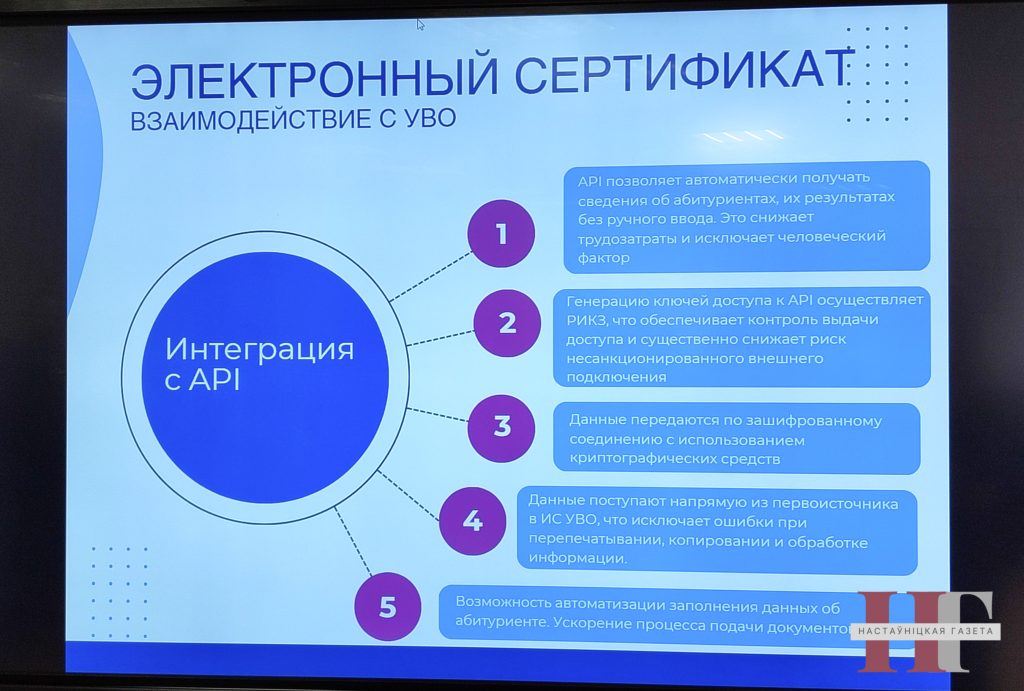
According to him, starting this year, E-certificates will also appear in applicants' personal accounts, but only those who have obtained an E-coupon for a visit to the university's admissions office will be able to use them:
"E-certificates will facilitate the prompt transfer of data to the higher education institution, which will reduce the workload on admissions offices. Incidentally, we have already tested this document submission process in practice with Yanka Kupala State University of Grodno and have found it to be fast, convenient, accessible, reliable, and effective."
Incidentally, last year, 15,500 people—one in three applicants—used the E-queue to submit documents to the university. While staying at home, they were able to book a convenient time to visit the admissions office. This feature significantly reduces the likelihood of queues occurring, especially during the first and last days of the admissions committees' work. This time, the service will be available 24/7 starting in June, but only for this year’s Centralized Examination and Centralized Testing participants.
"The application process is quite simple and consists of several steps: selecting a university, faculty, and major, mode of study, and the dates and times of the university visit. An application is assigned to the applicant. Two priority majors can also be assigned to it, which, firstly, helps quickly issue a new application if the main application is cancelled, and secondly, allows the higher education institution to collect statistics on the priority of majors," commented the Head of the Information Technology Department.
The Director of the RIKC recalled that, based on the work of the state commissions last year and the year before, the Ministry of Education made targeted adjustments to the key documents – the regulations on centralized testing and the instructions for organizing the centralized examination:
"According to these adjustments, special conditions will be created for CE and CT participants with special needs." Starting this year, applicants with mobile devices used exclusively for health control and support will be allowed to take the exam. This category, as well as students with musculoskeletal disabilities, will be exempt from the draw due to their health condition. The exam or testing center will assign convenient seats for them.
The second thing Dmitry Sergeyevich noted is the inclusion of an identification number on answer sheets and certificates instead of the passport series and number:
"This is done to protect applicants' personal data and simplify document processing. During the two years that certificates are valid, passports may be replaced. However, in this case, there will be no need to issue a new certificate, as it will contain an identification number that remains unchanged."
The director of the RIKC also added that from now on, only a simple one-line calculator can be used for physics and chemistry tests.
Another adjustment is related to the prohibition of taking materials on any media out of the auditorium where the Centralized Examination and Centralized Testing are taking place.