 Search
MINISTRY OF EDUCATION
OF THE REPUBLIC OF BELARUS

Education for the future of the country
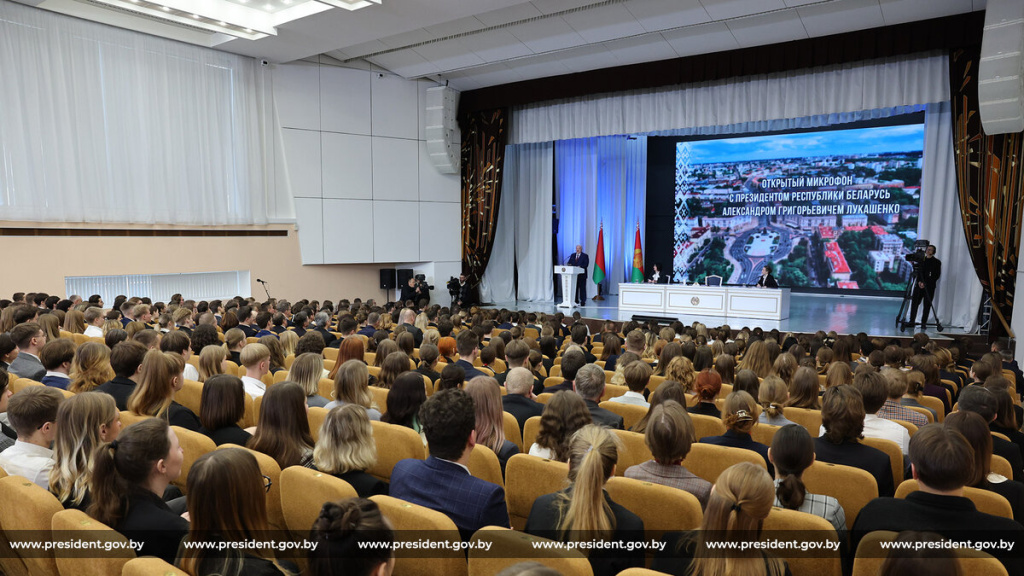
MINSK, 22 November - Belarusian President Aleksandr Lukashenko continues his meetings with Belarusian students as part of the Open Microphone with the President campaign.
Today the meeting takes place at Minsk State Linguistic University. The event is attended by the students of Minsk State Linguistic University, the teaching staff and students of other educational institutions. Among them are the Academy of Public Administration under the Aegis of the President of the Republic of Belarus, Belarusian State University, Belarusian State Economic University, Maksim Tank Belarusian State Pedagogical University, and International University MITSO.
Students should have motivation to learn and lead a healthy lifestyle.
“It is time for a person to think about their education and health themselves. If you want to achieve something, you are welcome. We open the door for you. There is no need to sit here, suffer, with absolutely no interest, while teachers are desperately trying to give some knowledge to you. This time has already gone,” the Belarusian leader stressed.
The head of state was briefed on the prospects of the university development.
As for the education process, the president stressed the importance of changing the ways of teaching foreign languages. “The main thing for the student is to work on the language. Every day. You need to read, translate a lot. That is what learning a foreign language is all about. You need real-life practice. I am saying that we need to significantly change the forms of teaching. Listening to a lecture, getting some translation as homework, spending some time in language rooms, as it once used to be, is not enough. All of it should be of course. But it is good as a start. Then one should go deeper in order to learn the language,” Aleksandr Lukashenko said.
According to MSLU rector Natalya Lapteva, the university is also training in digital linguistics, which combines language training with the use of information technologies. This is important also taking into account AI development.
Without denying the importance of this area, the president stressed that every university “wants to take over everything today”. “If you want to be an IT specialist, the linguistic university is probably not for you. Everyone should be computer literate today. Today’s life is about computers, phones, various devices,” he said.
Students of different nationalities greeted the head of state at the university and gifted him his quote about youth translated into 15 foreign languages studied at the university.
The head of state got familiar with the development prospects of other universities. Among them are Belarusian State University, Belarusian State Pedagogical University, Belarusian State Economic University, the Academy of Public Administration under the Aegis of the President of the Republic of Belarus and MITSO.
Andrei Ivanets noted that 5,000 foreign students are currently enrolled in Belarusian State University. "Work is underway to implement you instruction to set up a Belarusian-Chinese Center for Fundamental Research with Peking University, and also the Higher School of Biotechnology. We remember your instruction to create a world-class hub," Andrei Ivanets added.
Speaking about Belarusian State Pedagogical University, the education minister noted that the university annually enrolls about 1,000 students. "The most important thing is the content of education. There is still work to be done to make sure we train both future teachers and also educators of the patriots of our country," he stressed.
According to Andrei Ivanets, Belarusian State Economic University has been tasked with helping government bodies and developing social and economic development, import substitution and other economic programs. "So far, this university served as an educational center only," the minister stated.
Andrei Ivanets also noted that 100% of graduates of the Academy of Public Administration are placed into government jobs. This year 72% of graduates were employed with ministries and regional authorities.
"Don't forget that this is also your institution. No one knows it better than you," Aleksandr Lukashenko said.
Speaking about MITSO, the education minister stressed that this university trains personnel for the Investigative Committee and the Prosecutor's Office. "It also offers advanced training courses for the Federation of Trade Unions. About 14,000 trade union activists annually take such courses at the university," Andrei Ivanets concluded.
Aleksandr Lukashenko answered a question about the future of Minsk State Linguistic University.
Rector of Minsk State Linguistic University Natalya Lapteva noted that last year the university marked its 75th anniversary. “We try to imagine what our university will be like in the future. What is your vision of the linguistic university in 25 years?” she asked the president.
“I think it will become the Institute of Foreign Languages,” Aleksandr Lukashenko said unexpectedly, causing laughter and applause in the hall.
As is known, until 1993 the educational institution was called the Minsk State Pedagogical Institute of Foreign Languages. People know it as the Institute of Foreign Languages.
“Yet, I am not a fortune teller. We will raise this matter later in our conversation,” the head of state added.
The event at Minsk State Linguistic University is the third meeting of the head of state with Belarusian students. Minsk State Linguistic University is the second university after Vitebsk State University, which Aleksandr Lukashenko has visited for the first time.
“I have already managed to explore something here, talk to the rector, and the education minister. I can see a special atmosphere in the university and our hall. This is the atmosphere of intercultural dialogue. This is how it should be in a university where a large number of foreigners study. We are proud of this fact,” the president stressed.
The head of state said he was happy to meet with the humanist students of the university. “I have a humanities major myself,” he explained.
According to Aleksandr Lukashenko, information rules the world today. “There has been a lot of talk recently about the threat of WWIII. They say we are on the brink of this disastrous event. Thank God, humanity has still somehow slowed down and has not plunged yet into World War III, but a real information warfare has been going on for a lot time already and this is not just a clash but a full-blown information war,” Aleksandr Lukashenko said.
“This sphere of information, is formed by you, humanities students. You will do it even more actively once you graduate. You, future philologists, teachers, journalists, historians, specialists in other areas, will do it in the most active way,” the Belarusian leader said. “Tomorrow you will bring your ideas and thoughts to school classes or student auditoriums. Someone will start writing books, scientific or journalistic articles. Perhaps, you will become public figures: experts, politicians. Your education opens doors to a wide variety of fields. In this respect, we have a lot to talk about today.”
Aleksandr Lukashenko said that he also had some questions for the students. All of them in one way or another concern the topic of information sovereignty, the most important one from the point of view of ensuring the national security of the state, he added.
"Don't think that your participation is unnoticed. It is you that information propaganda targets primarily. Propaganda of alien values, holidays, traditions, historical concepts. Its purpose is to tear you away from your roots, to make you forget your history. It is important for me to see how you understand the essence of such information sabotage," the president said.
The second topic is geopolitics. The head of state noted that he is open to discussing the global news agenda and that he would like to know how well-informed students are on global matters.
"It is important for me to understand how you see the future of Belarus in a changing world. After all, this is your future, which you will build tomorrow. This is the future of your children," Aleksandr Lukashenko noted. “I would suggest that you do not hesitate to express your ideas. If you, relying on your knowledge and personal experience, see how you can improve the educational process, approaches to working with you, young people, please do not hesitate to voice your proposals. Let’s discuss. Your opinion is very important to me."
The president added that there are no restrictions on the topics and he is ready to answer all questions. "One of the topics for our conversation is changes (the assistants did not outline this topic but I offer to discuss this ). All kinds of changes. This is the topic or topics that we should go over today and talk frankly. Let's discuss this thing. If we talk about changes, what kind of changes do you want? It is easy to demand changes, but it is difficult to identify them, and then implement them. It is you who will effect them," the head of state said.
He noted that now the country is living through a period when one can speak out and express one’s point of view. The answer to the main question will be given on 26 January during the presidential election in Belarus. “Just do it like people with higher education, cultured, without noise. Do so as not to interfere with others, because each of you has different points of view, and I would like you not to step on the toes of each other while expressing your positions and point of view," the Belarusian leader said.
The education system in Belarus is no worse than that in other countries, and that's a given, Belarusian President Aleksandr Lukashenko said at a Q&A session.
Aleksandr Lukashenko told students about his own experience of getting an education. First in history, then in economics and, finally, in politics.
The head of state advised young people to make their career decisions very carefully and not to deviate from the chosen path afterward. In this regard, it is very important that first- and second-year students have on-the-job training, so that if they realize that it is not their thing, they will be able to try something else. “There should be a lot of practice, from the first year, or at least the second year! So that students will be able to understand whether they can handle it or not,” he said.
Speaking about his own experience, the president reflected on what shaped him as a professional apart from his teachers. “I put my mind into it. Whatever I did, I strived to be the best, ahead of others. Everything depends on you. If you got into the wrong place, just leave it quickly and start doing what you are into. Try to make the most of your potential. Everyone can achieve a lot. And the Lord will see it. He will lend a hand to those who are able and willing. You can do it. You are young, talented. Act! Do not waste a single moment. You need to do everything in due time. Because tomorrow it will be too late,” the president said.
Aleksandr Lukashenko urged young people to get their education in Belarus. “We provide a good education. And this education is for our children and for our country,” he said.
“Take your time. If you want to try your hand at something, go ahead and do it. I cannot close the door to you. You will still slip through the border and try your luck in a foreign country. But keep in mind that it is not all roses there. It is a common belief. Therefore, live in your own country, get an education here. The education is good if you want to study. Our people are naturally smart. Study, do not rush anywhere and be prepared that you may not succeed right away. Success is very unlikely to come overnight. You must be patient. The Lord will see and help,” Aleksandr Lukashenko said.
The head of state was asked about the role of mass media in modern society, and whether he believes they are the fourth estate, as Honore de Balzac called them, or they have already become the first estate.
“I would like to tell journalists once and for all: they are the fourth estate, not the first, not the second, not the third. The fourth one,” Aleksandr Lukashenko said.
The president emphasized that an information war is currently underway and there is a probability of a real, hot war. In such a situation, mass media will play an increasingly important role. The events in Ukraine are a case in point, as information and psychological operations are actively used there; they are based on intertwining and interweaving hoaxes, truth, and bias. In particular, this was the case with the events in Bucha. The blame was placed on Russia although in reality (this is backed by the evidence received from the intelligence service) it was the British special services that did it. “It was an information and psychological operation. Moreover, it was skillfully planned and well-timed, if I may say so. It was a very powerful information and psychological attack on the Russian Federation,” he added.
Aleksandr Lukashenko admitted that Belarus, if necessary, might also use PSYOP methods, because otherwise it would be impossible to survive in the information war.
“Information and psychological operations are not our invention. We will have to respond. But the truth must be at the core. The truth and only the truth,” the president emphasized.
“Media outlets play a huge role today. You [journalists] are on the front line,” the president said. He gave a piece of advice to everyone who wants to receive reliable information: “If you want to know the truth, read and watch state-run media.”
According to him, more than half of the population of Belarus trusts these media outlets. “It was not the case before. People have eventually realized who tells the truth. That is why people trust primarily state media. You should take such things seriously,” Aleksandr Lukashenko said.
“I am not saying that we should ignore other, alternative points of view. You should get familiar with them if you know how to analyze information and make the right conclusions,” the head of state said. “Amidst this information war, you must be very attentive, careful, cautious, and discerning. And journalists should help the public with this,” he added.
Aleksandr Lukashenko once again explained his attitude to “propaganda”, which is sometimes presented as a negative thing. “What's wrong with that? There is nothing wrong with it. All journalists, all politicians use propaganda, counter-propaganda and campaigning. They all do it. Some people from abroad would point fingers at someone and call them propagandists, but who are they themselves? We promote our way of life, our culture. We encourage people to do this. And who are you defending? Those who pay you,” the head of state said.
“The role of the media is now very significant. And, of course, the attitude towards journalists is very serious today. Therefore, I have paid and keep paying much attention to journalists as I understand that now a lot depends on them. It would not be an overstatement to say that they shape the image of not only the present, but also the future of our society,” the president said.
One of the questions to the head of state was about cross-cultural communication. A student of Minsk State Linguistic University, majoring in cross-cultural communication, noted that Aleksandr Lukashenko has a vast experience in communicating with representatives of different cultures and asked to share the formula for success in cross-cultural interaction.
The president noted that he has no special formula for success in this regard. "Sometimes you are so focused on an issue that you don't even think about cross-cultural communication. Because often your opposite number in negotiation, people you meet are not quite ‘culture-focused’ people; they do not quite understand our culture," he said.
“I always try to promote my culture, in cross-cultural communication. That is my job. I mean not only culture, but also sport, education, healthcare, economy, industry, agriculture, trade and so on. This is the essence of my work,” the Belarusian leader emphasized.
The president called the Festival of National Cultures in Grodno, which has already become the country’s iconic event, one of Belarus’ most important achievements in cross-cultural communication. “The festival is a truly great project. It keeps gaining momentum every year,” Aleksandr Lukashenko said. He stressed importance of state support for such events: “Organization and patronage are of crucial significance in intercultural dialogue.”
Another good example is the Marathon of Unity, which is now taking place in Belarus. “It has kicked off with a concert and keeps developing. The event also features a certain dialogue among the participants,” the president said. According to the president, things are not always smooth, but new experience is gained and appropriate conclusions are drawn.
A student of the BSU History Faculty noted that the History Faculty recently celebrated the 90th anniversary and that the building on Krasnoarmeyskaya Street in Minsk will reopen soon after renovations. By the way, this is where the history of higher education in Belarus began. The student asked the president to visit the History Faculty and give a lecture on modern Belarusian statehood. "You are the person who has witnessed many high-key historical events," he said.
Aleksandr Lukashenko immediately cautioned that the lecture would be long. Even two hours would not be enough to cover the major events. "If you agree to this, then I will think of the time to meet with you after the election. Even if I am not president, I am ready to meet with historians, I love history. But, probably, I will not be able to cover everything in detail so that you understand what we have achieved together with you," the head of state said.