 Search
MINISTRY OF EDUCATION
OF THE REPUBLIC OF BELARUS

Education for the future of the country
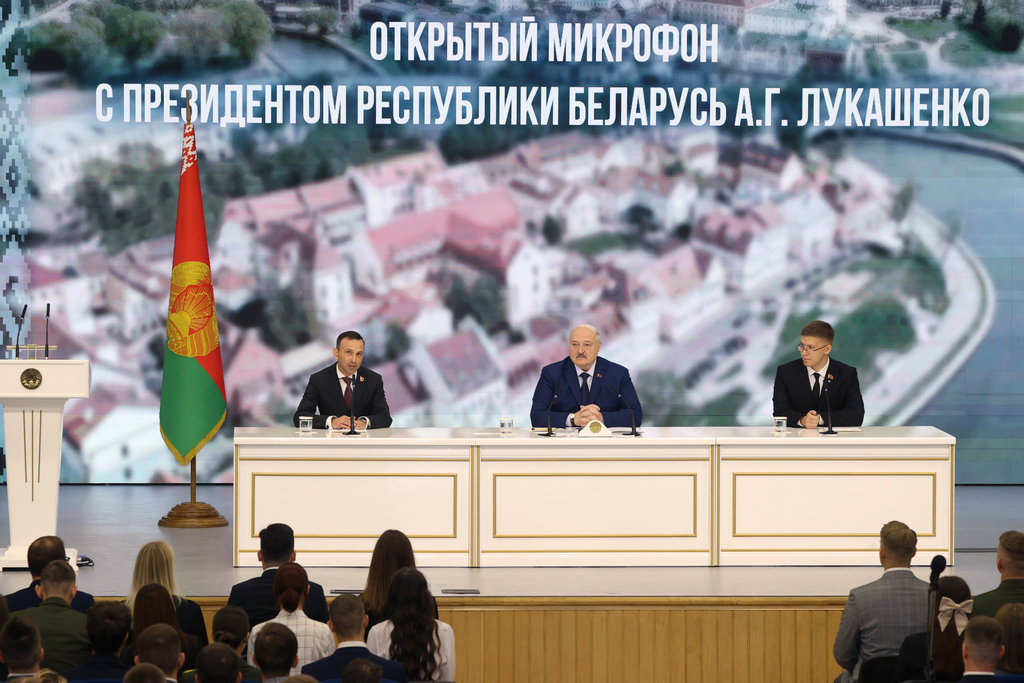
MINSK, 27 September - Belarusian President Aleksandr Lukashenko visited the Belarusian State University of Informatics and Radioelectronics (BSUIR) in Minsk on 27 September. The event continued the head of state’s meetings with students as part of the Open Microphone with the President project.
Belarusian President Aleksandr Lukashenko was shown the scientific developments of the Belarusian State University of Informatics and Radioelectronics (BSUIR) and other technical universities.
BSUIR presented scientific developments in various areas: standardization, improvement of defense capability, aviation, transport, road safety, medical and agricultural technologies and communications.
BSUIR cooperates with the defense sector of the Belarusian economy. Aleksandr Lukashenko asked whether they can make a highly accurate and jam-proof missile. Rector of BSUIR, Chairman of the National Council of Rectors of Higher Education Institutes Vadim Bogush said that they are working on this matter.
"If you accomplish this, you will prove that you are worth your salaries. Ask for anything you need. We will create all conditions for you. But we need this jam-proof missile," the head of state said.
When discussing another development of the university's scientists, Aleksandr Lukashenko urged to keep pace with innovations in unmanned transport.
The agenda also included social topics: availability of dormitories and improving stadium facilities.
Vadim Bogush informed the head of state about the state and prospects of the university's development.
"BSUIR trains specialists and conducts scientific research in three key areas: microelectronics, radio electronics and information technologies. We closely cooperate with country's enterprises. This year we have fully achieved the targets in terms of the admission campaign," the rector said. "We have launched three new majors: electronic engineering, which was worked out with domestic producers Planar and Integral, cyber-physical systems and digital marketing worked out together with the enterprises of the Belarusian Industry Ministry and Hi Tech Park."
According to him, currently about 9,000 full-time students are studying at the university. "We run the distant education programs and shortened courses for students after college. We pay special attention to on-the-job training. About 20% of our faculty is experts who work in some sectors of country’s economy," Vadim Bogush said. “Ideological and educational work has a place in the educational process too. It is built on the principles of labor and sports education, volunteer activities, close cooperation with local authorities and national government bodies."
"We are also engaged in extra-budgetary activities," the rector added. "Export of educational services is a key task for us. We closely cooperate with the CIS states, geographically distant countries, Africa, China. We also plan to increase the export by 5% by late September."
The meeting with the head of state was attended by representatives of the teaching staff, students and post graduates of other technical universities of the Belarusian capital. These are Belarusian National Technical University, Belarusian State Technological University, Belarusian State Agrarian Technical University, Belarusian State Aviation Academy and Belarusian State Academy of Communications.
Prior to the beginning of the Q&A session, Alexander Lukashenko has decided to speak on current issue. “School leavers should have equal conditions for university admission. “I am well informed about many processes in society. I am familiar with your academic programs. I monitor both entrance exam and graduate placement processes. I am also aware of what you write, talk and argue about,” Aleksandr Lukashenko said.
He said that he is primarily concerned about the accessibility of higher education. “The main thing is that each of our school leaver should have an opportunity to enter a higher education institution on an equal footing,” the head of state said.
The president said that in his time it was very difficult to enter university. The competition was very high, and the corrupt education system was also a big problem. Now there is another problem – insufficient applications to certain universities. This issue needs to be resolved, the president said.
“I am doing my best to ensure equal conditions for everyone,” he said.
Aleksandr Lukashenko revealed the reason for his meetings with students.
"I want to have an open and honest discussion, without being afraid that you will ask some questions to which I will not know the answer. So let's talk frankly about the matters that concern you, because you are the future of our country, however banal it may sound. It has always been like this: young people are the future of our country. It is very important to know your mood, your thoughts about the future. If our points of view do not coincide, let's find a compromise, as it should be among reasonable people, especially among Slavic people, Belarusians," Aleksandr Lukashenko said.
The president stated that the information environment has made people very open, frank and, unfortunately, vulnerable. "As future specialists in information technologies and electronics, you are aware of the speed of spreading and retrieving data about any of us. If we trust these data to our devices, we should realize that we are putting ourselves at risk in the information space," the head of state said.
Aleksandr Lukashenko noted that he often receives sociological studies that claim to capture a social portrait of today's youth. However, the president is confident that no such documents or reports on the pressing issues of youth policy will answer the main question: who will continue to build and develop Belarus?
“That is why I am here with you today. I think I will visit other universities in our country to answer this question. You came here to ask the president your questions. I came here to see you, understand and form my own opinion, and find an answer to the most important question for me today: who will continue our modern history, the history of sovereign Belarus? I am talking about it openly and honestly," the Belarusian leader emphasized.
The head of state pointed out that during such events it is important for him to understand whether young people feel their responsibility for the future of the country, how well they know the events and facts of the international and domestic information agenda.
"Adults always think about ways to explain things to you, but you see and understand a lot of things for yourselves and make very correct and wise conclusions. This is why I have come to you, expecting a frank conversation," the president said.
The head of state emphasized that Belarus will continue to focus on the engineering industry in the future. The scientific and technological development will be carried out in an accelerated pace.
“We will also pay closest attention to the training of engineers who will work at plants and factories, agricultural organizations tomorrow. Decent working conditions, including wages, social support and housing programs will be a priority of the state policy in Belarus the next five-year period,” Aleksandr Lukashenko emphasized.
“My morning usually starts with a review of the socio-political situation in the country and around Belarus, all over the world. Now we are all following the election campaign in the USA. I think the whole world is watching. Why? Indeed, it is an important country that largely sets the course of relations between the states. But we are following their campaign mainly because they have turned the political process into an interesting, exciting show,” Aleksandr Lukashenko said.
He also pointed out that modern politicians, expert and analysts of the constructive world majority have to talk about the real situation, repeating the same narrative: the world is on the brink of a new world war.
“Not to scare. But in order not to be distracted by nonsense, not to let the guard down and to protect national interests,” the president emphasized.
“I often say that Belarus is a small piece of land. This is, however, not just about the size of our Belarus. It is about the fact that the world is huge, but there's nowhere where we belong but here. Believe my experience. But if we look from the point of view of geopolitical interests of other countries, we will see an absolutely different picture,” the president said.
In his words, Belarus is six times as big as Belgium, five times as big as the Netherlands, more than twice as big as Austria or the Czech Republic. “We can host the peoples of the Baltic states and Moldova on our territory. We can accommodate, clothe and feed them,” Aleksandr Lukashenko said. “We have forests and wetlands - the lungs of Europe, a source of oxygen. We have well-cultivated fields, water, resources that will be worth their weight in gold in the future, because not every European country has such reserves and not everyone takes proper care of them as we do.”
According to the head of state, Germany plundered the Belarusian territory during the First World War, and it was Poland after Belarus was partitioned in 1921. “They brazenly pillaged our peat, timber and food. Meanwhile, Belarusians were starving,” he added.
“But the main thing is that we are blocking the passage towards Russia that is unprecedentedly and, as the West thinks, unjustly rich in resources. That is the reason for the political attacks and sanctions by the collective West against Russians and me,” the president said.
Resources are the number one issue, he said. It has always been so. “Today the situation is such that the West possesses the highest technologies in certain areas, which neither Russia nor Belarus possesses. But they need resources to produce finished products: drones, AI-based goods, and so on. They need resources and sources of rare earth metals. Where are they concentrated? First of all, in the Russian Federation. It has a huge territory and a disproportionately low population density. The technological West, which has always been ahead of us, has always looked eastward, hungrily eyeing this treasure trove of resources. This is what is happening now,” Aleksandr Lukashenko noted.
He said that every 100 years history repeats itself, but always at a higher level. “This is the essence of dialectical development and so on,” the head of state added.
According to the head of state, Belarus is strengthening allied relations with Russia, and has recently became a full member of the SCO. Belarus has built an all-weather and comprehensive strategic partnership with China and is deepening integration in the EAEU and CIS.
“I urge you to follow this agenda as it will determine the vector of your future life and the lives of your children and grandchildren. We are building long-term cooperation with the progressive world majority. You are to continue it and fill it with new content, first of all, in the economic sector,” Aleksandr Lukashenko said.
Sanctions against Belarus and its people are pure fascism! Aleksandr Lukashenko stressed that the West had imposed sanctions not against him personally (as they say, the dictator), but against the entire country and all Belarusians, including students, their parents and relatives. “This is fascism,” the president is convinced. “They teach us democracy. They demand humanity from us. This is not even double standards any more, but a complete degradation of human conscience and dignity.”
Belarus is an export-oriented country with an open economy, the head of state stressed. “This is why they are imposing sanctions on us, forcing us to look for new markets and components we do not produce yet. We are finding them. We know that all the difficulties are temporary. This is a time of opportunities,” the president said. In the global world it is impossible to halt the transfer of technologies or products, he added.
Sanctions encourage those sanctioned to look for possible ways out of the crisis situation. For example, design bureaus of large enterprises, the Academy of Sciences of Belarus, and domestic universities are actively engaged in import substitution. “It is the right thing to do, and we have no other way out if we want to survive. If we do not learn how to make components for our products, no one will need these products,” Aleksandr Lukashenko said.
Today Belarus produces high-tech buses and electric buses, cars, tractors and harvesters which are as good as the best imported samples. “We have achievements in microelectronics (we have even made our own laptop), in information technologies, pharmaceuticals, and biotechnology. I have only named a few things. The country is developing, and its people are developing too,” Aleksandr Lukashenko said.
“We will also make our own smartphone. We must do it, because gadgets, as you have recently noticed, have been turned into military weapons. This is already a matter of national security,” the president said.
“If you lose sovereignty, you can become a source of labor for transnational business. “It is important that you understand why modern politicians talk so much about national interests, sovereignty, statehood. If you lose all of this, you can be reduced from being citizens of your own country to being dependent on a foreign state, to a status of a source of labor for transnational business. Some people may turn well off, but not all of them. The majority will be worse off. We've been through this in our history,” Aleksandr Lukashenko said.
This is why, the head of state explained, he talks a lot about social justice and peace. “This is why we are working in this direction. Our peace initiatives absolutely do not contradict the measures to beef up defense capabilities, which we are forced to take today,” the president stressed. ‘We must respond to the emerging threats, project further developments, and find adequate solutions”.
“You will pursue a career in engineering and technology. I really want you to succeed professionally, start families, become parents. All this will happen,” the president said addressing the participants of the event. Aleksandr Lukashenko urged them to assess the situation comprehensively, to see the connection between domestic and foreign policy, and feel the zeitgeist. No matter where they will work and what career they will pursue, they will not be able to get away from politics, the head of state noted. The president urged young people to get a good grasp of politics, like they do with their studies.
“Geopolitical competitors make every effort to knock Belarus off the path to a new economic order,” he noted. “Sanctions, the fight on the media field to defend our values, traditions, and historical memory take a lot of energy and resources. This is true. But it is also true that we are still building our own economy, including such a trendy thing as digital economy, and are introducing elements of the 6th and 7th technological paradigms.” These elements include smart cities, smart transport, artificial intelligence, drones, and innovative products. This is what the younger generation will take over from us and build on after becoming certified specialists.
“And this is a reality in which we have already succeeded quite well. The developments of engineers from Planar, Integral, military industry enterprises, the Academy of Sciences, and technology parks at universities have already been introduced into the manufacturing industry and exported, and are even used in the space sector,” the president remarked.
The head of state emphasized that the country's engineering industry faces the most ambitious tasks. Its development is a strategic task that will shape the future of Belarus. The scientific and technological development will pick up pace. “We cannot stop, much less fall behind. I often say it figuratively: if we stop, we will be trampled over,” he said.
Therefore, as the president assured, the state will continue to invest significant funds in the development of promising sectors: robotics, nanoelectronics, complex self-learning systems and others.
“Now we are planning to set up hi-tech incubators - centers of progressive thought - at universities,” Aleksandr Lukashenko said. “For people like you - goal-oriented young people, driven, with fresh ideas, unconventional views on the solution of scientific and applied problems. Such a project, according to the president, should be implemented by BSUIR. The state, on its part, will provide the necessary support.”
Then, Lukashenko answered question about use of AI in his work. Does it help him process large amounts of information?
“Don't think that my head is different from yours. It's exactly the same. You just need to be able to systematize information,” the head of state said.
He added that he has to deal not only with a huge amount of data, but also to make decisions.
“You are fully aware that in a society like ours where most people are smart and educated, you simply cannot afford making a systemic, fundamental mistake. This is the most dangerous thing for any decision-maker, especially the one who runs a country,” Aleksandr Lukashenko remarked.
He said that he learned to analyze information and identify key points back in university. “It's like a library shelf. All the information is arranged, and when you need to make a decision, you turn to this shelf for the right piece of information, experience (this is very important). At the university, I was taught not so much to accumulate information, but rather to select what I need, to single out key points, and to systematize data,” the president noted.
He emphasized that experience is crucial for the work of the head of state: “Recently, I have appointed many relatively young leaders, senior officials. We need young people. But I believe they have already passed some stages. And my experience, my work as a president helped me see these people in action. They grew up on my watch. And while making personnel decisions I know what record every candidate has. Knowledge is necessary. This is the base, the foundation on which your experience rests.”
Speaking about technology solutions or artificial intelligence, Aleksandr Lukashenko said that he does not use them in analyzing information and making decisions. Moreover, he is cautious about technology. He mentioned the recent story with exploding pagers. He is sure that the higher the position a person holds, the more attention he/she should pay to security.
“I am afraid that this artificial intelligence will eventually take us hostage,” the president noted. He believes that it would be a disaster if at some point, as a result of technological advancement, humans will be sidelined. “This worries me very much and makes me wary,” he noted.
He recalled that in previous years, a human being was at the center of all processes, and this cannot be forfeited. “Yet I understand that we cannot do without this [modern technology]. We must master it, we must harness it,” the Belarusian leader said.
Next question was about Lukashenko’s attitude towards start-up projects.
“I find these issues to be the most important. This is the essence of our country's development,” the Belarusian leader said.
In his words, there can be as many ideas as there are people, and it is important to choose the most important and necessary ones. “We will definitely support everything that is necessary, relevant, and important. When there are no ideas, there is no development,” the president said.
He added that probably only one out of ten ideas can be implemented. “Our task, I mean the task of the authorities, who distribute funds and make decisions, is not to make mistakes. Although it is impossible to go without mistakes. But there should be fewer of them,” Aleksandr Lukashenko said.
The president said that he had repeatedly supported various proposals and projects, including in the IT sector. He is confident that it is necessary to keep moving towards the implementation of the necessary modern projects. “We will need this in order to withstand, to defend ourselves,” he said. “The more ideas, the better. Any idea must be real and well-grounded. When making a decision and allocating money, I or someone else must be sure that this idea would be needed tomorrow.”
Belarusian President Aleksandr Lukashenko spoke about his most difficult foreign trip.
The head of state said that all his foreign trips can be called difficult, because sometimes very intense negotiations take place behind the protocol events.
“Perhaps the most difficult was my foreign trip last year when we went to China, and then we had to fly to Africa,” Aleksandr Lukashenko said.
On his way from China to Africa, the president made a stop in the United Arab Emirates to hold several more working meetings. “Then we flew to the east of Africa. From the east we went to the west of Africa, and then again to the east. I think we completed our visit in Kenya. We went back to the Emirates where I met with the president to discuss some issues. I think the whole visit took more than a week. It was rather a difficult trip, because those are hot countries. I am a northern person. I cannot stand heat at all. Those days were a real test for me,” the head of state said.
Aleksandr Lukashenko said that he disliked foreign trips and bore long trips abroad very hard. “That is why I have never gone abroad on vacation throughout my presidential years. I can have a rest only when I am home, although it is almost impossible to switch off my presidential duties here. I love my country very much. I love its nature. It is a unique place we live in,” the president said.
The students asked the head of state whether he considered his visit to Yugoslavia in 1999 to be a difficult one. In those years, the country was constantly bombed by NATO forces.
“Well, yes, Belgrade. I have already forgotten about it!” Aleksandr Lukashenko said.
The president called those events pure fascism on the part of NATO. The alliance never guaranteed the safety of the Belarusian flight to Yugoslavia. Moreover, it absolutely neglected the fact that the leader of another country was in Belgrade and carried out air raids.
“We were approaching the border of Yugoslavia when the crew chief came in and said 'Comrade President, we have been ordered to descend to a one-kilometer altitude.' I realized what it was. They thought I would turn around as the situation was extremely dangerous. I told him to descend. He looked at me and warned of a possible attack. I told him that they would not attack. Through the window I saw that we descended and were flying above treetops. They saw that they did not frighten us. We approached the airfield, and they started bombing Yugoslavia. We landed under this cannonade. I did not even know that some of our delegation had parachutes with them. It was a really extreme trip. Serbs appreciated it,” the head of state recalled.
When asked whether he pays attention to a place a particular Belarusian university holds in the world ratings and whether it was important for national educational institutions to participate in such an evaluation system, Aleksandr Lukashenko advised not to pay much attention to such ratings, because, as a rule, they are not objective. “If universities want to be in this rating system (and some really do), then do your best. I pay almost no attention to it. They are all politically-biased,” the head of state said.
The real, objective assessment of higher education institutions is their demand among applicants, the president believes. For example, the head of state was briefed today that BSUIR’s export services went up by 5% year-on-year. Export services make almost half of the university's annual budget. “This is the real rating. When foreigners seek your education, that means a lot,” Aleksandr Lukashenko said. “It does not really matter how they compile their rankings. You know how they do this.”
“They are not fair there, you are right,” the BSUIR rector confirmed.
The president noted that Belarusian universities are popular among foreign nationals; a sufficient number of people come here for education. They often learn about universities not from ratings, but from word of mouth, which is much more reliable and objective.
As for the ratings, they can be biased. “I wouldn't be surprised even if China may act unfairly towards us in some things - it's competition,” Aleksandr Lukashenko said. According to him, even a country as friendly to Belarus as China, takes care of its own interests first.
“They consider everything. If you are nice to them, they will help,” the president said. One example of such cooperation is the construction by China of such large-scale world-class facilities as a swimming pool and a stadium in Minsk.
Aleksandr Lukashenko emphasized that Belarus is capable of producing high-quality sophisticated goods not only in education but also in the real sector of the economy, though not in the same volumes as in larger countries. Thanks to the support of the Belarusian side, some countries, such as Venezuela, have created new industries in the civil and military sectors. “We know how to do everything that is needed. Those who need to learn something know who to approach,” the head of state said.
Aleksandr Lukashenko also noted the idea of smart villages is worth considering.
“It's simpler than a smart city. We will see a smart city becoming a reality in the next five-year period. A village is much smaller. You have developed a 'smart city' solution. Design a concept of a village and we will make it 'smart'. The people there are somewhat different, but nevertheless this idea is feasible. If you have such an idea and people who can implement it, let's do it,” Aleksandr Lukashenko said.
Students noted that in the long term, the development of smart villages can have an impact on the structure of the country, because agriculture is one of the mainstays of the Belarusian economy.
“I agree with you. I share this view. We need to decide what functions this smart village will have. Maybe it won't need some of those functions that a city has. This is a thing of the future. We have a peasant soul, our heart is in the countryside (we are kind, compassionate people, we are ready to share everything we have, we have a good sense of collectivism). There can be no Belarus, no country without the countryside. Moreover, the village today successfully feeds and clothes the city. Therefore, we pay a lot of attention to the development of rural communities, and use the most advanced technologies there. And it is easier to do this in the village, because a city is a city - hundreds of thousands of people – but the village is compact. Interesting people live there, they will be curious about it.”
A smart city concept has been developed in Belarus. It provides for introduction of advanced IT solutions in the city infrastructure that will eventually lead to the creation of a smart city. Such a concept should prioritize the comfort and convenience of residents. Digitalization is expected to make cities safer, more convenient, and easier to navigate through a broader use of modern solutions in housing and utility services, construction and territorial planning, transport infrastructure, healthcare, education, law enforcement and other areas.
Aleksandr Lukashenko also shared his thoughts on who could lead Belarus after him.
“I don't want to offend anyone; I don't want to praise myself here. Remember, I said that presidents are not made, presidents are born. If you don't have the basic traits and qualities of a president, then don't even think of going into this,” the head of state said. “I am thinking a lot about it now. It is a transitional period and I realize that someone will come after me and lead the country. Bad, good... You will evaluate this later, and compare. Understanding comes through comparison. And I think: there are people in the public eye. You see less, I see more as I have them all in front of my eyes, starting with your rector and ending with the prime minister and speakers of our parliament. They are all in front of my eyes. “
Aleksandr Lukashenko admitted that he couldn't recommend a particular person, if he was asked about it. “Honestly, I don't know. But all of them, who are in the public eye, have unique qualities. Unique. They have some great qualities better than mine. And yesterday I thought: if these qualities were combined in one person, it would be a unique person and an ideal president,” the Belarusian leader noted. But the main thing is experience, Aleksandr Lukashenko emphasized: “Recently I have appointed a lot of relatively young people to top positions. It is necessary to have young people. But I think that they should pass some stages. My experience, my life as president has allowed me to see these people in action. They grew up before my eyes. When appointing, I realize that this or that person has experience. Knowledge is necessary. This is the foundation to build on.”
One of the participants of the meeting highlighted the importance of personal connections relations of the president.
“It’s part of the job description. You have a point. A lot depends on your personal connections. The next president, after Lukashenko, should be ready to prove himself on the international arena. So that they would seek to meet with him, negotiate with him,” Aleksandr Lukashenko said. “The future Belarusian president will have to prove himself. It is important for the country.
In this regard, the head of state recalled his visit to Belgrade during the NATO bombing. It became a serious page in the history of relations with Serbia and a serious page for the image of Belarus.
“Therefore, one should also understand that personal connections are very important,” the Belarusian leader emphasized.
Aleksandr Lukashenko explained in which cases nuclear weapons could be used to defend Belarus and Russia.
"As I said at the patriotic forum [held on 17 September], an attack against Belarus will trigger World War III. Recently, Vladimir Putin has confirmed it having amended the nuclear doctrine. An attack on Russia and Belarus will trigger a nuclear response. He confirmed what I said. It was the main point of my statement. As soon as they attack us (NATO is still NATO. Americans and Poles are already lined up along the border, especially the Polish border. We know that the Polish leadership is already rubbing their hands), we use nuclear weapons. Russia will defend us," the president said.
"If we use nuclear weapons, they will do the same. And against Russia too. So Russia will use the entire arsenal of weapons. This will be a world war. The West does not want this. They are not ready for it. We tell them openly: the red line is the state border. You step on it, we will respond immediately. We are preparing for this. I am talking this openly and honestly," Aleksandr Lukashenko added.
“There are certain boundaries, limits. We need to negotiate with Ukraine, we need to stop this war. Look, World War II and the Great Patriotic War were terrible wars. Belarus was destroyed. But your generation, even mine, were able to have normal relations with Germany. The human memory heals wounds. It is exactly what will happen with Ukrainians. But we should not go any further. We have already made a mess of things. We need to negotiate. This is my firm position,” the Belarusian leader said.
“We maintain contacts via certain channels with Ukraine. I openly said about this. You see our relations With the Russians. We are trying to use these contacts to make things work. Zelensky so far does not hear this and does not want to listen. Why? Because the Americans are pushing them forward in this war,” the president emphasized.
According to him, this war is good for the United States. “It is very profitable. Russia is not the main thing. It is important to weaken Europe. Don't think that Americans and Europeans are one big family. Americans do not need a strong Europe. They want Europe to fight in Ukraine, they will give them money. They just need to turn on the machine and print it. Dollar spreads the inflation globally. They print money. They gave more billions to Volodya Zelensky: “Go and fight!” Moreover, they [the U.S.] keep their military-industrial complex busy, they supply their weapons. Meanwhile, the money stays in the USA”.
The US itself doesn't want to go to war, because American society reacts badly to body bags coming back into the country. “That's why they proxy the war. Let the Ukrainians die there. Let them and Russians kill each other. Let them fight and we [Americans] will give them something to fight with,” the Belarusian leader said.
Aleksandr Lukashenko recalled his thesis that high-tech Western Europe could be developing successfully in partnership with the resource-rich Russia. Now, on the contrary, Germany is forced to close down plans and factories as they can't withstand the competition. “It was important for them to keep Nord Stream working, to keep gas flowing to Germany (Russians and Germans built these pipelines). Everything should have been done to keep gas flowing through these pipes to Germany. Cheap gas,” the president noted.
U.S. presidential candidates Donald Trump and Kamala Harris have a consensus on China policy, Belarusian President shared his point of view.
China is the main competitor of the United States, Aleksandr Lukashenko said. By encouraging the continuation of the war in Europe, they are trying to weaken the EU and Russia to finally deal with China. The head of state recalled the AUKUS project in the Indo-Pacific region. “They are setting up this bloc. They are already uniting against China,” he noted. “This is their goal. Now they are openly talking about it. They have a consensus on China policy in the United States. Whoever in power, Trump, Harris or Biden, they have a consensus in this regard. It's in the U.S. interests.”
“Once the world stops using the U.S. dollar, they are not viable. Without the dollar, they will cease to be a world power,” the president said.He also noted that the U.S. brain drains the world, paying huge salaries as they can print dollars. “Brain drains there and works for the Americans,” the president stated.
During the Q&A session, the head of state commented on plans to produce Belarus' own mobile phone. At the request of the students, he showed the mobile phone that he uses. He even made a call to demonstrate how this device works.
According to him, this phone uses a KGB-developed solution that is protected from eavesdropping because communication is encrypted. When an attempt is made to intercept a conversation, an intercepter hears gurgling sounds; the voice is decrypted only when a signal is transmitted to another similar device. Due to these features, the device is quite heavy, but work is underway to make it more compact. The president explained that this phone is carried by his adjutant.
About 70 people can communicate with the president via secure line. To get access to this line, a personal approval of the head of state is needed.
According to Aleksandr Lukashenko, some countries have already acquired this Belarusian solution. This solution was developed by cryptographic specialists of the KGB. Belarus inherited great cryptographic competencies from the Soviet Union and preserved them.
Then, the head of state was asked whether the issue of holding a general parade with the participation of all allied countries that helped defeat the Nazism in 2025 had ever been discussed.
“It has not been discussed and will not be discussed for certain reasons,” the president replied. He pointed out that Western countries had not invited Belarus and Russia even to the recent commemorative events in Auschwitz, even though it was the Soviet army that liberated the concentration camp. Or to the events marking the opening of the second front. “They keep saying that they won and saved the planet from the Nazism while the Soviet Union had nothing to do with it. They want to memory hole the world and, above all, to recode us,” said Alexander Lukashenko.
“So they will not invite us anywhere. They will not hold any events together with us. I am absolutely sure about this,” the president added.
The head of state was asked about three recently signed decrees on pardoning people convicted of extremist crimes. “Do you believe that they have repented? Are you going to continue doing this going forward?” one of the participants of the Q&A session asked.
“I will keep doing it. This is my job, it is a constitutional duty of the president to pardon people. We must fulfill our duties. Therefore, we will keep it up. As for the first part of your question, I hope so. Of course, some of them say that they repent, promise to mend their ways, to leave other people alone but then break their promises,” the president said.
Yet, Aleksandr Lukashenko believes in giving people a chance.
“I have a piece of advice for you that is based on my experience – stay in your country. We see these fugitives. They call my press secretary and plead: “Tell the president!” They write me letters: “We made a mistake, we want [to return]. I say: “Okay, we have a commission led by the prosecutor general. Apply to the commission, make your point. They all posed with white-red-white flags and so on. We have this. We have a whole archive. When they apply, we check what they did. They think that we do not know what they did,” the president said.
According to the head of state, everyone should explain the rationale behind their actions, because it can be anything. “It happens, as we say, that people just go bonkers, make mistakes. We are interested in them returning home. This is very important for me personally. But if they are guilty, they must be held to account in line with the law. Apply to the commission,” he said.
Speaking about pardoning about a hundred people, the president emphasized that no one pressured him to do it. “Nobody asked me to do it, it was not a matter of bargaining. We studied the issue. One [of the convicts] was sick. Kostusev is his name. He and Zenkovich were planning to shoot up the president's helicopter as it was landing, and so on. Why would he want to do it? He was diagnosed with cancer. Why keep him in prison? They released him. There are others there. There are sick people, and lame people. All kinds of them. Well, we released them. Purely for humanitarian reasons,” Aleksandr Lukashenko said.
The head of state remarked that many people, especially young people, did not get a grasp on the situation and just jumped on the bandwagon. “It's one thing to be in the crowd, and another thing to commit a criminal offense. We are sorting this out as we are trying to bring them back. Yet, those who have done really bad things will not return. And thanks to Yuri Zenkovich, who revealed how they had planned this coup. They had even planned who would do what and in what regions, and in the center. He said: “I was responsible for legislative matters, for appointing people to the KGB and elsewhere,” the head of state said.
Aleksandr Lukashenko noted that the money the West gives Belarusian exiles and the opposition is spent by the top brass and does not reach the rest: “The money is channeled through them, and they spend it. And these, I call them poor fellows running to the West, have no money.” As a result, these people who fled to Poland, for example, have to settle for lowest-paying jobs, like washing dishes.
“That's why I say: don't get carried away and never rush. Be patient. Give yourself time. That's exactly what you have to do. Never rush anywhere. Never. Yes, you have to move fast, but don't hurry. Tread cautiously. Think twice, double check, get together and share your thoughts with each other. Get anchored to your land,” the president added.
The information war is underway, the president said. He cited the activities of the Ukrainian special operations unit CIPsO (Center for Information and Psychological Operations) as an example: “They lie non-stop.”
“Remember Bucha in Ukraine? It was an information and psychological operation, and our intelligence clearly established who was behind it. It was the UK, they organized it. Our guys did well. They tracked everything: license plates, their arrival there and so on,” Aleksandr Lukashenko revealed some details. “These are information and psychological operations. They do it all the time.”
“We try to respond. But I believe that truth should be at the core. Why lie?” There is the information war going on today. Thank God it's information warfare for now. God willing, it will not turn into a hot war. We are trying to counter them in the information war,” the head of state emphasized.
He said that the launch of First News TV Channel, a new TV channel in Belarus, was a response to the actions of ill-wishers in the information war.
“I criticize it too. But it has started doing better. It's a good channel. There is something I and my youngest son discovered recently. It turns out we don't watch other channels anymore. We turn on this channel to get daily news run-downs,” Aleksandr Lukashenko said.
According to him, it is important to raise the level of other domestic TV channels. “This channel has already overshadowed the others,” the president noted.
He also said that he often watches the Belarus 3 TV channel which covers the cultural life of the country.
The head of state said that back in the day he was offered to engage in research work at the university. The proposed topic dealt with the Resistance Movement in Western Europe during World War II. However, Aleksandr Lukashenko declined the offer, because the work of a researcher, in his opinion, is extremely hard.
“I closely follow and pay much attention to the work of scientists and teachers. I myself was a teacher, a lecturer. For me, this is the most difficult job. The hardest work is to write theses, do research. I simply idolize these people,” the president said.
According to the head of state, the work of a university rector is the most interesting one. “I view this as a dream job. It's interesting: young people around, you communicate with students, you talk. I really like it. That's why, when I appoint rectors, I envy them,” said Aleksandr Lukashenko.
Belarusian President was also asked whether to expect a new selection of candidates for space travel as it was before the flight of Marina Vasilevskaya, the first cosmonaut in the history of sovereign Belarus.
“Vasilevskaya’s flight was the result of my agreement with President Putin. I understand what a flight into space is. It’s a lot of training. It's a lot of money,” the head of state noted.
When asked by one of the female participants of the meeting, Aleksandr Lukashenko said: “It's not a question of getting you into space, I can arrange for you to join the squad of cosmonauts. But you will fly, maybe, in 11 or 12 years. This is the way things are done. This is how cosmonauts are trained. It's all about time, time, time... Well, you'll have a slight advantage because you're a girl. After all, there are practically no women in the Russian cosmonaut program”.
The president said that when Belarus was planning the first flight, the idea was to send a female representative. A selection was carried, as a result of which Marina Vasilevskaya flew into space. “It was an exception. Whether you fly depends on your abilities. Of course, I will provide my support. But this will take years. It is you who will have to work on a certain [scientific] program: either you will breed cockroaches there, roughly speaking, or grow plants at the station. It will already be a specific program. And it will take years.”
Aleksandr Lukashenko emphasized that a cosmonaut is a profession and requires professional growth. “He who strives for their goal will achieve it sooner or later,” the president assured.
The president was asked to comment on the statement that IT specialists supposedly do not contribute to the country's economy, despite the favorable conditions and high wages provided for them. The head of state was also asked about the future of the HTP.
"Nowadays, economic development is impossible without IT specialists" Aleksandr Lukashenko emphasized. However, speaking about the future development of the IT industry, he urged not to focus on the HTP. According to the president, the HTP has played its part. It will continue to work, and the state intends to further support it. But the park has already fulfilled its main mission. The effect was quite unexpected. When the HTP was established and received a number of preferences, specialists from the National Academy of Sciences and large industrial enterprises became concerned and began to develop their own IT skills. This is how they formed their own strong IT teams, which already surpass the teams of the HTP. "This is the main point. This march across the country started from there," the head of state explained.
"It is impossible to develop the economy properly without IT technologies and It teams," the president said.
One of the participants of the event recalled the president's statement that Belarus should not lag behind in training personnel for modern warfare and, in particular, specialists in drones and electronic warfare. In this connection, a proposal was made to open military studies departments at universities in order to train specialists that are in demand in such areas.
Aleksandr Lukashenko called this initiative reasonable and instructed the Defense Ministry to work on it together with university rectors. The president believes that students of a university such as, for example, BSUIR, can become the best drone operators because they specialize in the topic. “The Defense Minister shall work it out, consult with the rector and report back to me,” the head of state said.
Belarusian President Aleksandr Lukashenko told Minsk students about his agricultural experiments:
“I do experiments too. You know, I love farming. I visit agricultural fields every day. It is important for me to make sure that academics fulfill their promises,” the head of state said.
One of the participants of the Q&A session asked the president about his top five favorite crops. “Well, we can't do without potatoes. Apples are second most important crops for Belarus. We are an apple land. I need to think about it. I could also name plums, apricots, and so on,” the head of state said.
The president recalled that some time ago he laid an orchard where he planted cherry plums and peaches. Watermelons have also taken root in Belarus; Aleksandr Lukashenko had actively encouraged people to grow this crop. “Today, this crop is already cultivated throughout the country. And it has produced a good harvest this year. Watermelons are sweet this year, because the weather was so dry. This crop is not demanding, though you need to fertilize the soil. I just scattered them onto the ground and they grew on their own. I could name many crops. They are very important to me. But potatoes and apples are above all,” said Aleksandr Lukashenko.
The head of state went on saying: “I would name corn. It is very important for us. A true helper. The climate has become drier. Corn grows well, especially in Gomel. This saves us. If we look from this perspective, I can also name clover and flax, since the latter is on our coat of arms. Well, I have already named five.”
Talking about his agricultural experiments, Aleksandr Lukashenko mentioned the cultivation of potatoes. Generally speaking, in order to test the quality or viability of certain crop varieties, the president plants them on collective farm lands, which are nicknamed his experimental fields. He does that in order to see what comes out of it.
It is worth mentioning that some of these lands are good, but half of them is not fertile. “What I see there can be projected into the entire country,” he said. Most of the products grown on this land are distributed among people.
There are also many animals and poultry in the president's farm. “They give me horses and other animals. What do I need them for? I'm a village man. Okay, let it be. Children from the neighboring agro-town come to ride these horses. There are 15 cows. They are the best. I have recently been gifted a cow from Brest Oblast. It produced 59 liters of milk per day in September, in the third month after giving birth. Six buckets per day! Well, she's a real beauty. She is the best,” the president said.
Aleksandr Lukashenko added that he adjusted the diet for this cow so as not to overfeed her with concentrates. After all, this is not very good for her and for the milk quality: “Yesterday they told me that she gave 49 liters. But I do not overfeed her with concentrates, because this is not okay. We put her on a proper diet.”
The president also tests various models of equipment. “Right now I'm testing a watering machine. Listen, we have so much water, so many rivers. And a field next to a river is dry. Why don't we water our fields? I visit southern countries, Asian republics - they have irrigation systems everywhere. But we can't pour water from a river onto a neighboring field. So I'm experimenting with this now. And after that this experience might be scaled up throughout the country. But I have to try it myself first, I have to see. No, I'm not standing there with this watering machine. There is a person who does that. And I go there to see how things are going,” the head of state said.
Following a Q&A the students gifted Aleksandr Lukashenko a painting made using neural networks.
The author of the idea explained that the initial task that was set for the artificial intelligence was to show Belarus as an intellectual, technological, progressive, agrarian nation and to feature its national symbols and its place in the world. In the process of finalization, a laptop and a tractor were added to the image, the planet was enlarged to make the outline of Belarus more clearly visible. In the background there is a noticeable transition from dark to light color, which can be interpreted either as the prosperity of the country or as bright Belarusian fields. The painting was completely generated by the neural network.
“A very good thing, made using such an interesting method,” the president said as commented on the gift.
At the end of the meeting the head of state thanked the participants and organizers of the event and gave the youth a valuable piece of advice: “Always take your time and do not rush”.