 Search
MINISTRY OF EDUCATION
OF THE REPUBLIC OF BELARUS

Education for the future of the country
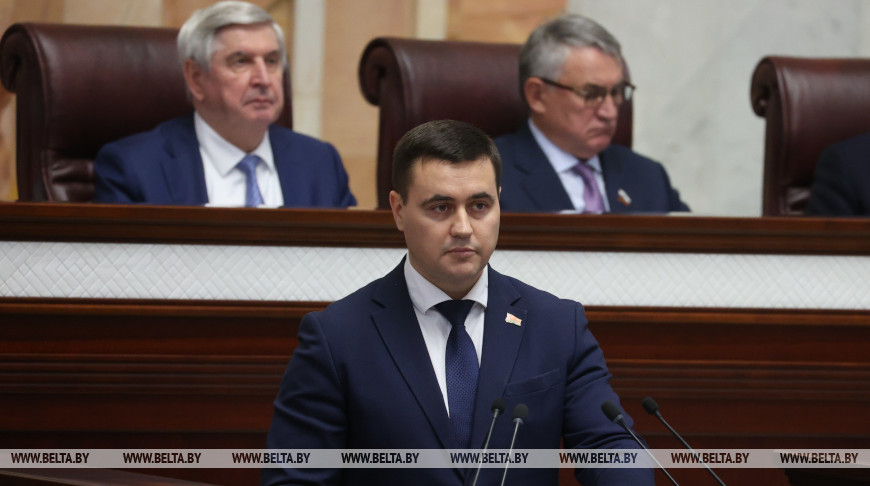
Minsk, June 17. The meeting of the 66th session of the Parliamentary Assembly of the Union State of Belarus and Russia is taking place at the House of Government.
The agenda of the meeting includes consideration of the draft decree of the Supreme State Council of the Union State “On Amendments and Additions to the Decree of the Supreme State Council of the Union State “On the Union State Budget 2023” and approval of the report of the Council of Ministers of the Union State on the execution of the Union State budget 2023.
The session will feature a ‘government hour’ on the formation and development of the common scientific and educational space in the Union State. The heads of the Ministry of Science and Higher Education of the Russian Federation, the National Academy of Sciences of Belarus, the Education Ministry of Belarus and the Ministry of Education of the Russian Federation will get MPs familiar with joint activities in science and education.
Given the delegation of a new deputies to the Parliamentary Assembly of the Union State of Belarus and Russia by the National Assembly of Belarus, the session will consider organizational issues. The meeting will feature the election of deputy chairpersons of the Parliamentary Assembly, chairpersons of the commissions of the Parliamentary Assembly from the Republic of Belarus.
The leaders of the Ministry of Education of the Republic of Belarus and the Ministry of Education of the Russian Federation, the Ministry of Science and Higher Education of the Russian Federation, and the National Academy of Sciences of Belarus informed the deputies about joint activities in the field of science and education.
When the floor was passed to the Minister of Education Andrei Ivanets, he emphasized that the development of cooperation between the relevant ministries of Belarus and Russia is an important part of integration processes within the Union State. Key issues are training of highly qualified personnel, implementation of youth policy and education of the younger generation.
Andrei Ivanets focused specifically on the priorities of joint work. Among them are educational and methodological support for the educational process, cooperation in the field of assessing the quality of education, advanced training for teachers and industrial training of specialists, development of contacts, exchange of experience between teachers and students, holding joint educational and scientific events, formation of the future human resources potential of our countries, as well as training of teaching staff.
The most significant areas of bilateral cooperation are training of blue-collar workers. In this regard, jointly with the Ministry of Education, a draft Concept for ensuring the quality of vocational education of the CIS member states has been developed, agreed upon by the ministries of education of the CIS member states. The concept will be used for comparative analysis of the development of vocational education systems.
The Association of Colleges of Belarus and Russia was established. Here the emphasis is on promoting the sustainable development of vocational education, increasing its role, and developing social partnership. “This is an important breakthrough aspect that will allow us to integrate and unite the levels of special and vocational education in the two countries,” said Andrei Ivanets.
In terms of educational and methodological support for the educational process, our countries have successful experience of interaction. In this regard, the parties intend to rise to the next level. Thus, at a joint meeting of the boards of relevant departments of both states in Minsk on May 18, the issue of the possible transfer of Belarusian textbooks to Russian colleagues for use in solving the problem of creating unified textbooks for educational institutions of general secondary and vocational education was discussed.
In 2021, the Association of Schools of Belarus and Russia began its work. Now it is already a professional communication platform for the pedagogical communities of our states. It unites more than 500 schools, of which 170 are from the Belarusian side. Within the framework of the Association there is a section of pedagogical classes.
Among the main priorities of interaction is the development of an inclusive approach in education. In cooperation with Russian colleagues, the project “Inclusive education: a favorable environment for realizing the potential of every child” is being implemented. As part of it, training visits have already taken place to exchange effective teaching experience.
A solid joint work is being carried out at the level of higher education and science. BNTU and Pskov State University are implementing the project of the Advanced Engineering School of the Union State. It is aimed at network training of highly qualified engineers of the new generation who are capable of providing our countries with technological sovereignty.
To train young scientists and stimulate their interest in scientific activities, a number of joint Belarusian and Russian initiatives have been implemented. A draft Regulation on the Union State Prize for Young Scientists has been prepared with interested parties.
Equal rights in receiving education are ensured at the legislative level. From 2024, Russian citizens can enroll in Belarusian universities for full-time free-of charge (budget) and paid education based on the results of the Unified State Exam. More than a thousand budget places in pedagogical, engineering, agricultural and other areas have been allocated so that children from Russia could enter all universities of Belarus. Of course, they will have the opportunity to find employment related to their subjects of study at enterprises in both Belarus and Russia. Currently, about 2.5 thousand Russians are already studying at universities in our country.
Issues of educating the younger generation and youth policy are also an integral part of the work to strengthen the Union State. More than 700 patriotic events are held annually as part of interuniversity cooperation.
“The formation and preservation of the historical memory of the younger generation is the most important task for teachers in Belarus and Russia. Of particular importance there is the Belarusian-Russian patriotic project “Memory Train”. In August it is planned to hold a festival of military-patriotic camps and clubs “We have something to be proud of, we have something to protect!” It can become another effective form of educating children and youth of the Union State,” emphasized Andrei Ivanets.