Carefully preserving memory in every corner of our native land
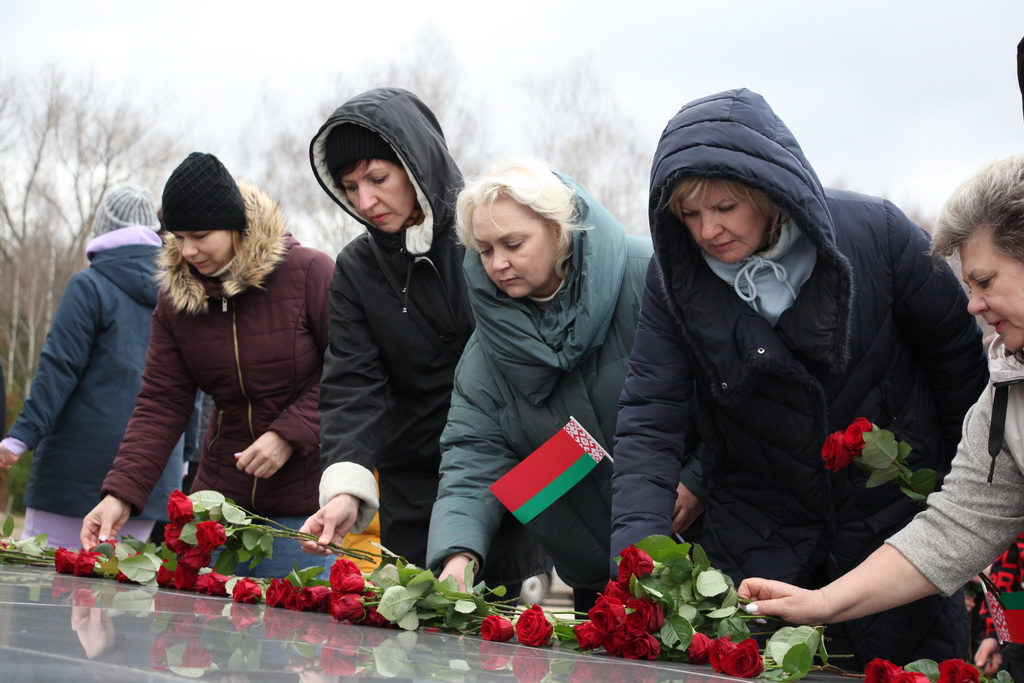
Litavets, 5 April. The leadership and staff of the Ministry of Education, as well as students and working youth, honored the memory of the innocent victims at the site of the Litavets memorial complex in the Dzerzhinsky district. Here, on 14 January, 1943, the fascist punitive forces brutally killed more than 190 civilians. Among the victims were 58 children. The fascist monsters did not even spare the babies sleeping in their cribs.
Here, in a small village in the middle of the forest, the Nazis destroyed entire families of silent witnesses of those terrible events. Women, children and old people were put in a chain, ordered to hold hands and everyone was gunned down. The demons turned the village itself into ashes.
Litavets is considered the sister of Khatyn. Nowadays, the sacred memory of the burned village is cherished by grateful descendants. Schoolchildren and teachers tell those who come here from different places to honor the memory about facts that make you think about the high price of life under a peaceful sky on your native land.
That is why 33 days before the Great Victory, Belarusians are trying to fill this time with noble deeds. For example, this spring they are actively participating in the "Give the forest a new life!" campaign, which was launched last year on October 11 by our President.
With a view to the distant future, representatives of the education sector today also rooted with their own hands on a 4-hectare plot of the Negorelsky educational and experimental forestry enterprise of the Belarusian State Technical University more than 20 thousand seedlings of Scots pine and 5 thousand wild birch. This is love for your homeland and nature, education of patriotism and a careful attitude to work and the natural wealth of the country.
In an interview with journalists, the Minister of Education of Belarus told about another important initiative – the “Garden of Hope” campaign. Schoolchildren – participants of the national project already take care of 3110 hectares of fruit and berry gardens, which are assigned to 1834 educational institutions. “Despite the fact that the school year has not yet ended, industrial and agricultural enterprises have been assigned to all institutions so that children can not only get used to work, but also see what our real sector of the economy is doing today. This is labor education and career guidance, so, of course, schoolchildren all over the country are participating in this wonderful campaign. And the “Garden of Hope” is the campaign that we are conducting on behalf of the Head of State. And now more than a thousand schools have garden plots and gardens. They require constant care and renovation. Therefore, all of us, jointly with young people and schoolchildren, are trying to be role models,” added Andrei Ivanets.