A course on quality will explore how Belarus prepares the future workforce through admission in 2026
Published:24.04.2026
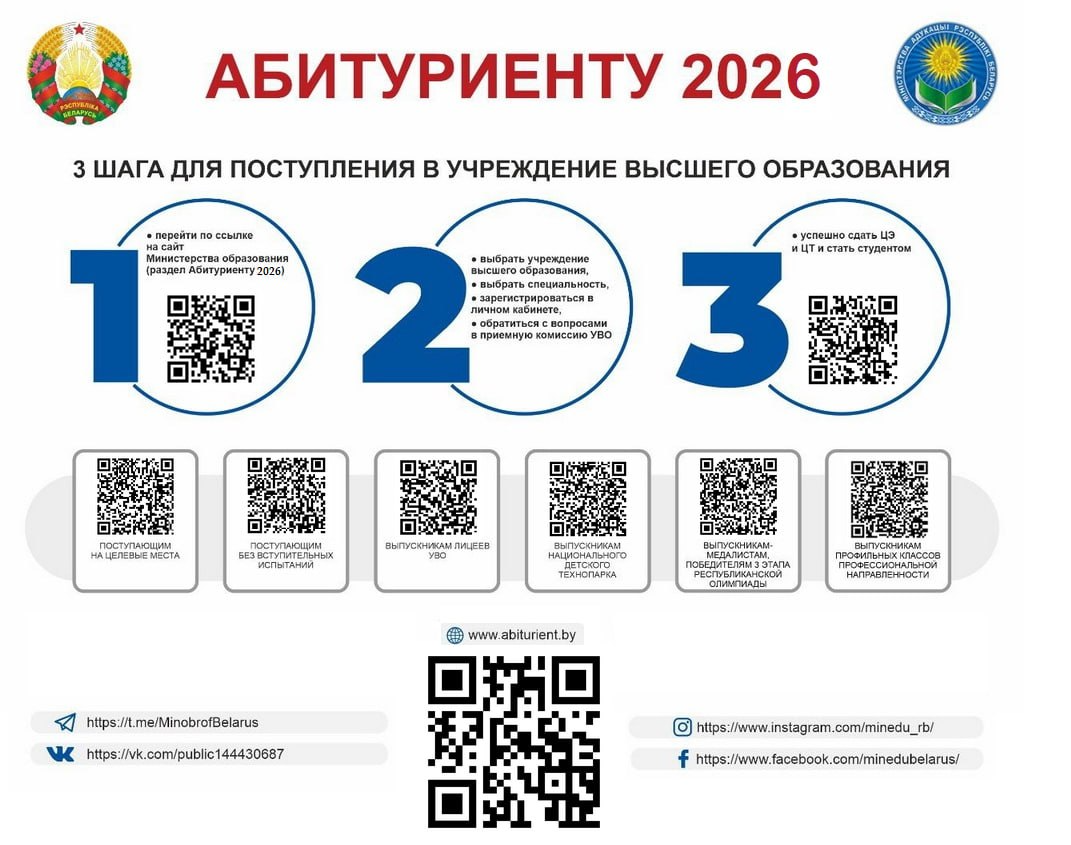 The 2026 admissions campaign is in full swing and fully complies with the Admission Rules approved by Decree No. 23 of the President of the Republic of Belarus of January 27, 2022. The regulatory framework for the admissions campaign remains stable, ensuring predictability and transparency of the procedures for applicants and their parents.
Regulatory Framework and Public Oversight
The State Commission for Monitoring the Preparation and Conduct of the Admissions Campaign, approved by Decree No. 463 of the President of the Republic of Belarus of December 31, 2025, oversees compliance with the law at all stages of the admissions process. In 2026, it was granted additional powers to monitor the conduct of regional university Olympiads, which provide preferential admission.
The Olympiads were held in February at 21 regional higher education institutions. The winners were recommended for admission without entrance examinations. The application process and admission of this category of applicants will take place from June 27 to July 2 (before the start of the main admissions campaign).
Updating the Admission Rules
Decree No. 463 clarifies certain provisions:
- The requirement for work experience to match the educational profile for applicants to correspondence (distance) education has been eliminated.
- A specialized entrance examination has been introduced for the subject "History of Belarus in the Context of World History," which is studied in grades 10-11 instead of the subject "History of Belarus."
- The categories of beneficiaries have been clarified in connection with the establishment of the College of the Ministry of Internal Affairs.
Admission Targets
Universities plan to accept 49,100 applicants (+900 compared to 2025):
- 33,100 (+1,300) for state-funded education;
- Fee-based – 16,000
Targets of state-funded admissions:
- Engineers – ~7,700 (23.3%);
- Teachers – 3,900 (11.8%);
- Healthcare workers – 3,700 (11.2%);
- Farmers – 3,100 (9.4%).
Colleges (SSE): planned admission – 38,900 people, including state-funded – 31,400, fee-based – 7,500. Full-time state-funded: 30,080 (based on general basic education – 22,300, based on general secondary education and vocational education – 7,780). Correspondence/distance learning – 1,360.
Vocational and technical education (VTE): planned – 29,000 people. Full-time – 28,100 (23,370 based on general basic education, 4,350 based on general secondary education, and 414 based on specialized education). Evening – 701, part-time – 185, and distance learning – 15.
Targeted Admissions (Empoyer-funded)
The development of the targeted training plan is being finalized: for universities, the plan is approved by May 1, and for colleges – by June 1.
Key Features for 2026:
- A list of targeted training majors has been approved (Resolution of the Ministry of Education of January 6, 2026, No. 12), including priority areas: pedagogy, medicine, engineering, and agriculture.
- Personal data protection has been ensured: examination committees have limited access to information about applicants taking internal examinations.
- Information on the competitive status of each recruitment agency is published on the university websites.
- The client enters into agreements with all citizens who have applied for targeted admission (including the deadline for submitting documents), informing them in writing of the terms and conditions.
- Entrance examinations include practical assignments in physics, mathematics, chemistry, and biology.
- There must be a competitive selection (at least one applicant per place) at the client's location on the application deadline. If there is no competitive selection, the university will notify applicants within the next day that the vacant spots will be transferred to the general selection.
Targeted Admission Deadlines:
- Application Submission: June 27 – July 2;
- Entrance Exams: July 4–10;
- Admission: By July 12.
By the end of 2025, 5,900 people have been enrolled under the targeted training program.
Main Admission and Entrance Exams
Admission based on interview results remains an option for graduates of specialized professional-focused classes. Requirements: at least 8 points in specialized subjects, at least 7 in other subjects, and a recommendation from the pedagogical council. Interview questions are posted on the university websites. Applications are accepted and interviews are conducted during the first days of the campaign.
In 2026, approximately 4,000 people are expected to graduate from engineering classes, 4,600 from pedagogical classes, and 3,600 from military-patriotic classes.
The list of majors most in demand in economics remains unchanged and includes 69 programs. Applicants with the appropriate achievements can enroll in these programs without entrance examinations.
Admission without entrance examinations
College medalists and honors graduates are eligible for admission without entrance examinations:
- At regional universities – for almost all majors, with the exception of medical programs, International Relations, International Law, Jurisprudence, Economic Law, Public Administration and Law, Asian Studies, and majors with creative and athletic tests.
- At metropolitan universities – only for majors from the list of majors most in demand in economics.
Graduates of university lyceums (BSU, BNTU, BrSU, VSU named after P.M. Masherov, PolesSU) with an academic performance of at least 8 points in all subjects (at least 9 in specialized subjects) are admitted to their universities without entrance examinations.
Graduates of the National Children's Technopark are eligible for admission without entrance examinations to a number of in-demand specialties, provided they have a recommendation from the Technopark Supervisory Board and successfully pass interviews at the universities.
Admission of Russian Citizens
Russian citizens can enroll in state-funded programs based on their Unified State Exam (USE) results. The approved list includes approximately 850 places in 131 majors at 30 universities. After graduation, specialists will be able to find employment at Belarusian companies.
Ensuring equal competition terms
To protect the rights of applicants applying on a general basis, preferential quota limits have been established:
- At least 20% of state-funded places in all specialties (at least 10% for medical programs) are reserved for competition based on the results of the Centralized Examination (CE), Centralized Testing (CT), and entrance examinations.
Information Support and Career Guidance
The Ministry of Education provides comprehensive information to applicants:
- A "Applicant 2026" section has been added on the official website with up-to-date schedules, lists of specialties, and entrance examination questions.
- Press tours have been organized at leading universities, and hotlines are available at educational institutions and the Ministry of Education.
Large-scale national events were held: the "Education and Career" forum (February 12-15, 46 universities, 70+ colleges, 40+ employers, over 22,000 participants) and the Open Day (March 21).
The Belarusian education system is fully prepared for the 2026 admissions campaign in strict compliance with legislation and the objectives defined by the Head of State and the Government. Fair, equal, and transparent admissions conditions have been created for all applicants.
The Ministry of Education wishes every applicant confidence, successful completion of their entrance examinations, and the fulfillment of their professional plans for the benefit of Belarus.
Detailed admissions schedules, application forms, lists of specialties, and entrance examination questions are available in the "Applicant 2026" section on the official website of the Ministry of Education of Belarus.
Press-center of the Ministry of Education.